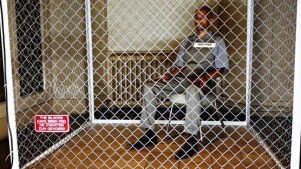
Anyone who saw the Guardian’s recent Edinburgh Festival review of Brett Bailey’s controversial installation ‘Exhibit B’ – featuring African men and women sitting inside cages, with labels stating “The blacks have been fed”, and others chained to chairs and beds in equally dehumanizing poses (seemingly to challenge audiences to reflect on the brutalities of European racism throughout the colonial era, and to specifically critique the violent practices and enduring legacies of the 19th century “human zoos”) – might be interested in the online petition that has been established to oppose and boycott its forthcoming display at the Barbican Centre in London (23rd – 27th September 2014).
The petition’s organiser is Sara (Sar’z) Myers, and full details about why she and hundreds of supporters consider Bailey’s project to be a racist exhibition can be viewed online at https://www.change.org/p/sir-nicholas-kenyon-withdraw-the-racist-exhibition-exhibit-b-the-human-zoo-from-showing-at-the-barbican-from-23rd-27th-september
The following URL links to a 7-minute, online slide show presentation about ‘Exhibit B’, which provides a sufficient preview to enable prospective audiences and interested parties to determine for themselves whether Brett Bailey’s work is racist, or not: http://www.ukarts.com/Shows/Exhibit-A/
The link to the afore-mentioned Guardian review is also available here:http://www.theguardian.com/stage/2014/aug/11/-sp-exhibit-b-human-zoo-edinburgh-festivals-most-controversial

Beyond the mainstream UK print and online arts media, Simon Woolley’s comment piece for OBV (Operation Black Vote) explores more pointedly why ‘Exhibit B’ demonstrates numerous serious abuses of power in ways that have the perverse effect of perpetuating and reinforcing the very stereotypes and prejudices the South African artist Brett Bailey claims to be challenging: http://www.obv.org.uk/news-blogs/brett-bailey-and-new-white-supremacy
As Simon Woolley concludes:
“I guess it’s one way to get international fame, lauded by liberals, and thanked by Black actors for getting some miserly short-term employment.
But in the real world for the vast majority of Black Britons, and other Africans on main land Europe – where this exhibition has been equally controversial – Brett Bailey’s human installation that mimics the nineteenth century Victorian ‘human zoo’, which exhibited Africans in cages, is but a modern-day facet of white supremacy.”
– Simon Woolley (Director, OBV: Operation Black Vote)
As I see it,‘Exhibit B’ is a racist installation – both in its conceptualisation, and in terms of the actualities of its display – and its continued presence in high-profile arts venues around Europe (such as the Barbican in London) merely serves to reinforce (and does not challenge) centuries of physical and psychological racist violence. Audiences do not need to be shocked into reflecting on the types of brutalities meted out to individuals like Saartjie Baartman, Ota Benga and countless other African (and African Diaspora) men and women over the centuries. A review of the actual archival documentation is harrowing enough!
If Brett Bailey and the Barbican really wanted to draw attention to the traumatic legacies of colonial violence, then they should have considered working with black-led organisations such as FLT (Fondation Lilian Thuram: Éducation Contre le Racisme) to present an accurately researched anti-racist exhibition about ‘human zoos’ (sensitively curated, in consideration of the needs of diverse, multi-racial prospective visiting audiences) from which everyone could obtain insights – as the Quai Branly Museum sought to do when it collaborated with Lilian Thuram (and Pascal Blanchard from ACHAC) on the Paris-based exhibition, ‘Human Zoos/Zoos Humains: L’Invention du Sauvage’ ( 2012). Whilst I am aware that the Quai Branly’s staging of the ‘Human Zoos’ exhibition also had several major flaws, at least its overall approach was anti-racist instead of simply being sensationalist, and most certainly did not feature provocatively dehumanizing, racialised, ‘live performance’ tableaux.
So, in view of the above, I fully concur with Simon Woolley’s summative assessment of Brett Bailey’s work, when he states:
“If Bailey had the decency to ask Black people here or anyway else if we thought this work helped Black people, or continued to degrade and perpetuate an inferiority myth? I would bet that 95% of Black people would say the latter.”
– Simon Woolley (Director, OBV: Operation Black Vote)
…and, in consequence, I’ve added my signature to the thousands of others who’ve supported Sara Myers’ petition to date!

Leave a reply to Debates about the “The War on Black Bodies,” situated in contrasting cultural spaces in New York and London | Museum Geographies Cancel reply